
SUMMARY
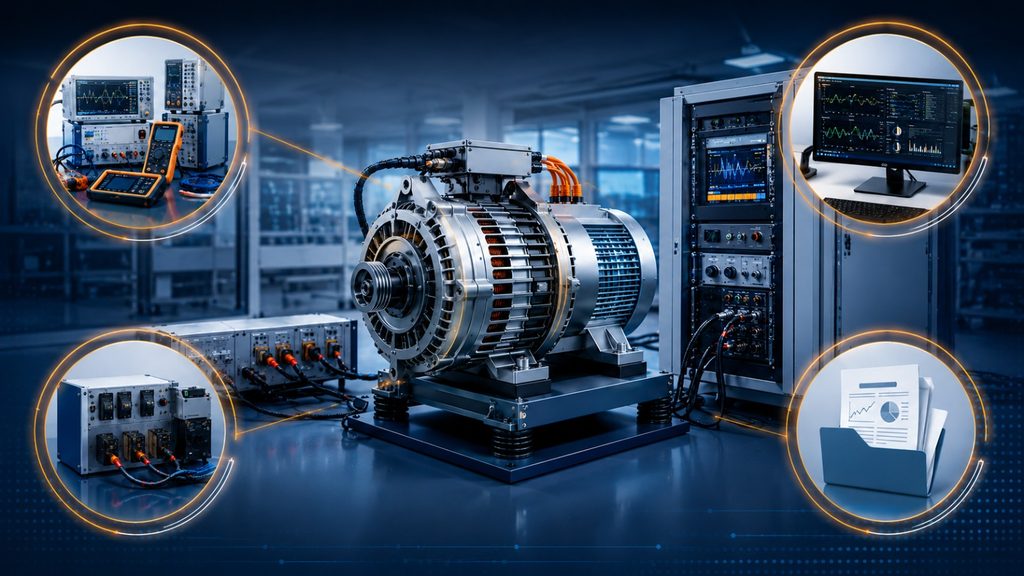
An industrial alternator manufacturer required a comprehensive automated test system to validate both static and dynamic performance of alternators with minimal human intervention. TMCS delivered a PXI and cRIO-based platform built on LabVIEW, integrating multi-parameter electrical measurement, RTD thermal monitoring, vibration analysis, and software-controlled load banks. The system executes thirteen distinct test types, auto-logs results, and generates structured reports, significantly improving test throughput and data traceability.
CHALLENGE
Alternator qualification requires execution of a broad set of static and dynamic tests — including insulation resistance, high-voltage dielectric, heat run, efficiency, and vibration — each demanding simultaneous acquisition from disparate instruments across electrical, thermal, and mechanical domains. Manual test execution introduced operator dependency, inconsistent data logging, and limited traceability. The client needed a unified automated platform capable of orchestrating these tests sequentially, controlling resistive and inductive load banks, and producing audit-ready reports without dedicated manual record-keeping.
SOLUTION
TMCS engineered a LabVIEW-based automated alternator test system anchored on an NI PXIe-1092 chassis with PXIe-8840 controller and a cRIO-9063 (Zynq-7020 FPGA) for real-time distributed I/O and load control. The acquisition layer integrates NI PXIe-4357 RTD modules, a PXIe-4480 sound and vibration module, NI 9215 analog input, and NI 9476 digital output for load bank switching. Third-party instruments — Power Analyzer, Hioki RM3545 Resistance Meter, HBM KT40B Torque Transducer, and Autonics MT4W multi-meters — communicate via RS-232 through NI PXIe-8430/8 serial interface cards. The software provides role-based access control, auto and manual test modes, configurable test sequences, real-time alarm monitoring, and automated PDF report generation with a historical data dashboard for multi-machine comparison.
SPECIFICATIONS & FEATURES
| Specification / Feature | Description |
| Test Platform Architecture | NI PXIe-1092 chassis with PXIe-8840 embedded controller and cRIO-9063 (Zynq-7020 FPGA) for distributed real-time acquisition and load control |
| Analog & RTD Acquisition | NI PXIe-4357 RTD input modules (x2), NI 9215 ±16 V AI module, and Masibus 85XX RTD Scanner for simultaneous multi-channel thermal and electrical measurement |
| Sound & Vibration Measurement | NI PXIe-4480 1.25 MS/s Sound and Vibration Module with BNC interface for drive-end and non-drive-end vibration analysis |
| Power & Electrical Measurement | Power Analyzer and Autonics MT4W multi-meters (x8) for voltage, current, frequency, power factor, and harmonic measurement |
| Torque & Speed Measurement | HBM KT40B Torque Transducer and Selec PIC 512 RPM Meter for mechanical performance characterisation during dynamic tests |
| Load Bank Control | Software-controlled resistive and inductive load banks via NI 9476 32-channel digital output module, enabling automatic load switching in both Auto and Manual test modes |
TEST TYPE / PARAMETERS MONITORED
| Test Type / Parameter | Description |
| Insulation Resistance (IR) Test | Dielectric insulation measurement conducted before and after HV testing; values acquired from IR meter via operator-assisted channel selection and logged to the database |
| High Voltage (HV) Dielectric Test | Applied voltage withstand validation using configurable HV meter channel selection; pass/fail result automatically recorded after test completion |
| Winding & RTD Resistance Test | DC resistance of stator windings measured with Hioki RM3545 Resistance Meter; RTD resistance acquired from dedicated channels with ambient temperature and humidity entry |
| Open Circuit & Short Circuit Tests | Voltage, current, frequency, and power factor acquired from instruments while alternator speed is incrementally varied; readings logged per operator-defined intervals |
| Heat Run (Temperature Rise) Test | Continuous monitoring of electrical parameters and multi-point RTD temperatures over extended run periods; data logged at defined time intervals to track thermal stabilisation |
| Vibration & Efficiency / Overload Tests | Drive-end and non-drive-end vibration captured via PXIe-4480; efficiency, overload, voltage regulation, over-speed, and kW losses data acquired from connected instruments and logged for analysis |
TECHNOLOGIES USED
The system is developed in National Instruments (NI) LabVIEW for real-time data acquisition, instrument control, and automated test sequencing. Hardware platforms include NI PXIe-8840 controller, NI PXIe-1092 chassis, NI PXIe-4357 RTD modules, NI PXIe-4480 vibration module, and NI cRIO-9063 with C Series I/O modules (NI 9215, NI 9425, NI 9476). RS-232 serial communication via NI PXIe-8430/8 interfaces the Power Analyzer, Hioki RM3545, Masibus 85XX RTD Scanner, Autonics MT4W meters, Selec PIC 512 RPM Meter, and HBM KT40B Torque Transducer.
ADVANTAGES / BENEFITS
The system reduces manual operator involvement across all thirteen test types, improving consistency and test throughput. Auto and manual modes provide operational flexibility, while software-controlled load banks eliminate manual switching errors. Centralised data logging, alarm history, and automated PDF reporting ensure full traceability, audit readiness, and accelerated engineering analysis through the multi-machine dashboard.
CONCLUSION & FUTURE SCOPE
The TMCS alternator test system establishes a robust, scalable automated validation platform meeting industrial qualification requirements. Proven across static and dynamic test regimes, it delivers consistent, traceable results with minimal human dependency. Future scope includes expanded alternator variants, remote monitoring integration, and statistical process control analytics for production trend analysis.