Reduce development risk before physical systems exist — validate control logic, fault handling and edge cases entirely in simulation.
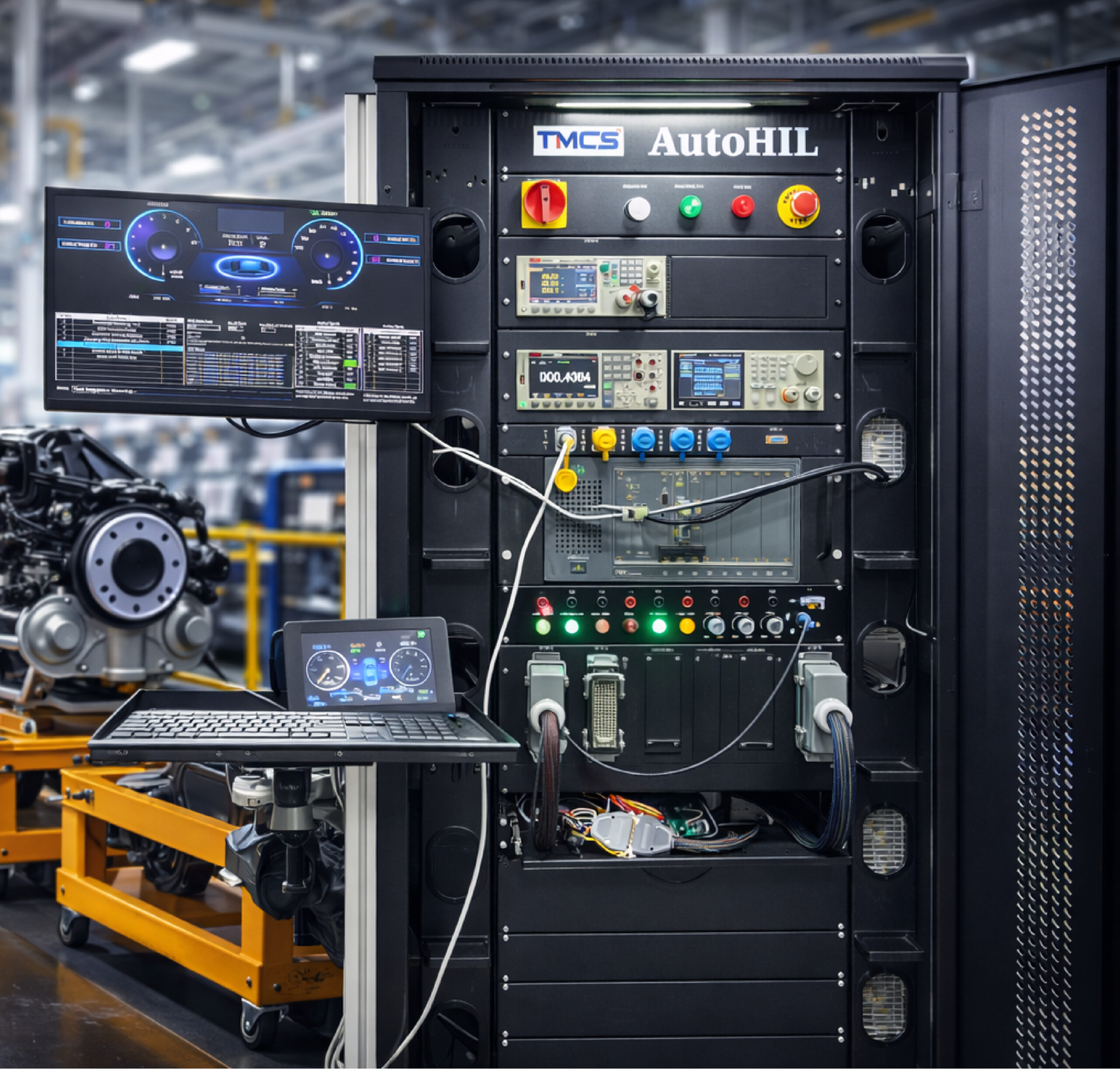
Hardware-in-the-Loop (HIL) simulation runs your actual ECU, VCU, BMS, PLC or motor controller against a real-time simulated model of the physical system it will control, instead of the real hardware. The controller “sees” realistic sensor and actuator signals generated by the simulation and responds exactly as it would in the field — so integration and fault-handling issues surface while the software is still in development, not after a physical prototype has already been built.
TMCS builds these environments on NI VeriStand, PXI, LabVIEW and TestStand, giving engineering teams a validated, closed-loop test platform that runs the real control logic continuously against a real-time plant model — catching problems weeks or months earlier than physical testing alone would allow.
TMCS is a leading engineering solutions company specializing in automated testing, simulation, validation, and NI-based engineering platforms. As an NI Certified System Integrator, we help organizations across Automotive, Electric Vehicles, Aerospace, Defence, Industrial Automation, and Energy sectors validate complex embedded systems with confidence.
TMCS delivers HIL validation as a five-stage engineering process, from requirement to regression-ready test suite.
Functional and fault-response requirements mapped against the product specification
Vehicle, motor, actuator and plant behaviour simulated in real time on NI VeriStand
Controller connected via CAN, CAN FD, LIN and Ethernet exactly as it would be to the real plant
Fault scenarios programmed and automated closed-loop sequences run in LabVIEW/TestStand
Results captured, trended across builds, and re-run automatically as control software evolves
Modern vehicles, aircraft, industrial machines, and energy systems depend on increasingly complex software and embedded controllers. Traditional validation methods often rely heavily on physical prototypes, making testing expensive, slow, and difficult to scale.
| Aspect | Physical Prototype Testing Only | HIL Simulation |
|---|---|---|
| Testing Stage | Testing begins after a physical prototype is available | Testing can begin early, before the complete physical prototype is built |
| Hardware Dependency | Requires physical hardware and prototypes for testing | Uses real controllers with simulated plant and system behaviour |
| Test Coverage | Limited by hardware availability and physical test conditions | Enables repeatable testing across a wide range of operating conditions |
| Fault Testing | Some faults can be difficult, costly, or unsafe to reproduce physically | Fault conditions can be simulated safely and repeatedly |
| Testing Speed | Testing cycles can be slow due to hardware setup and configuration | Automated scenarios can be executed rapidly and repeatedly |
| Cost | Requires multiple prototypes, test setups, and physical equipment | Reduces dependence on repeated physical prototypes and test setups |
| Repeatability | Results can vary due to physical conditions and manual setup | Identical test scenarios can be reproduced consistently |
| Development Cycle | Issues may be discovered later during physical testing | Issues can be identified earlier, accelerating development and validation |
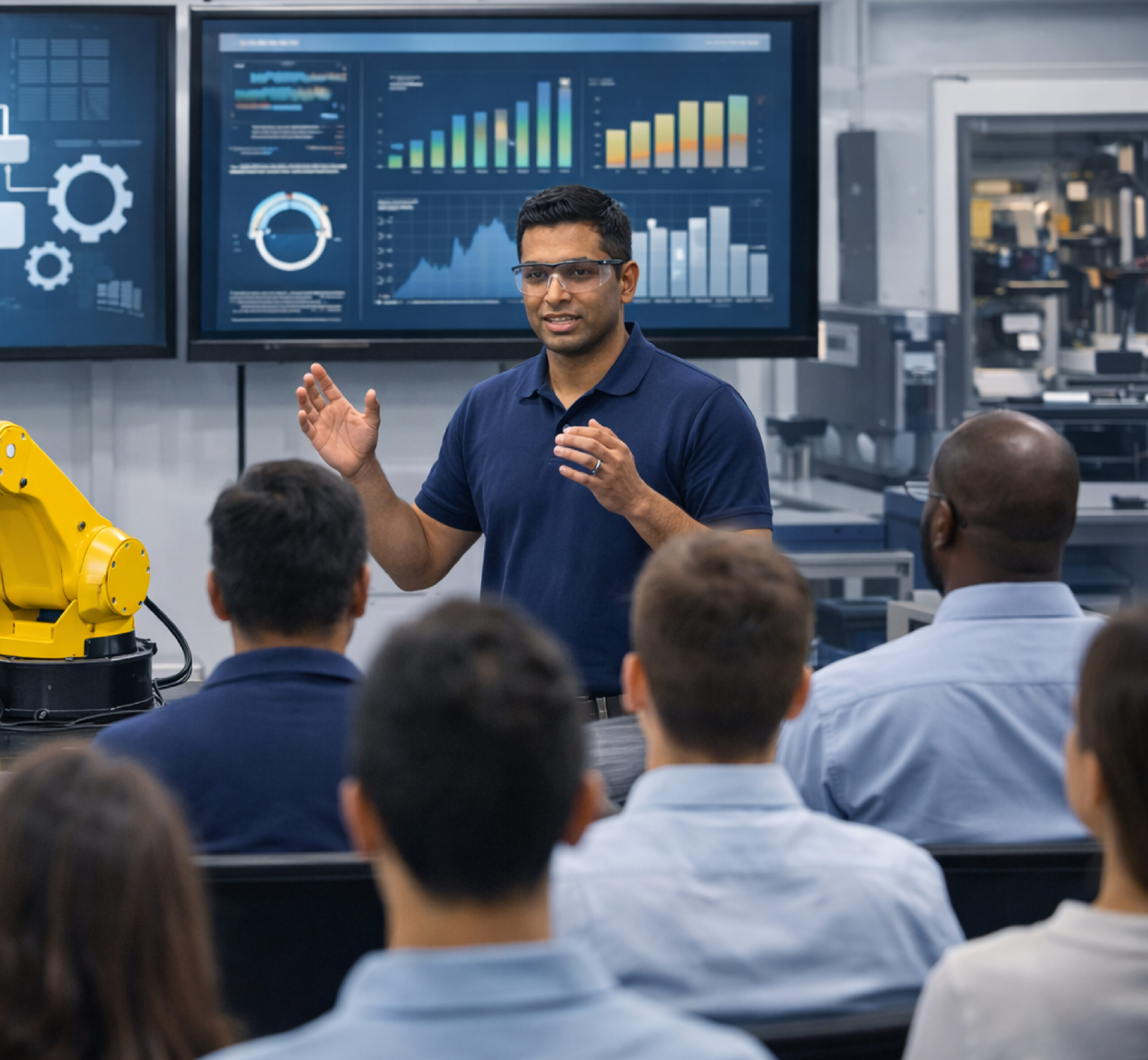
Hardware-in-the-Loop testing connects real controller hardware to a real-time simulation environment that accurately replicates actual operating conditions. Engineers can validate functionality, safety logic, communication networks, and fault handling under thousands of scenarios without requiring physical systems.
Validated EPAS/HPAS systems with multi-actuator simulation, delivering accurate, repeatable testing for R&D and production.
Enabled real-time VCU validation with automated CAN/I/O testing, ensuring reliable and high-performance validation.
Enabled repeatable electric-bus VCU testing through real-time drive-cycle and fault simulation, reducing prototype dependency.
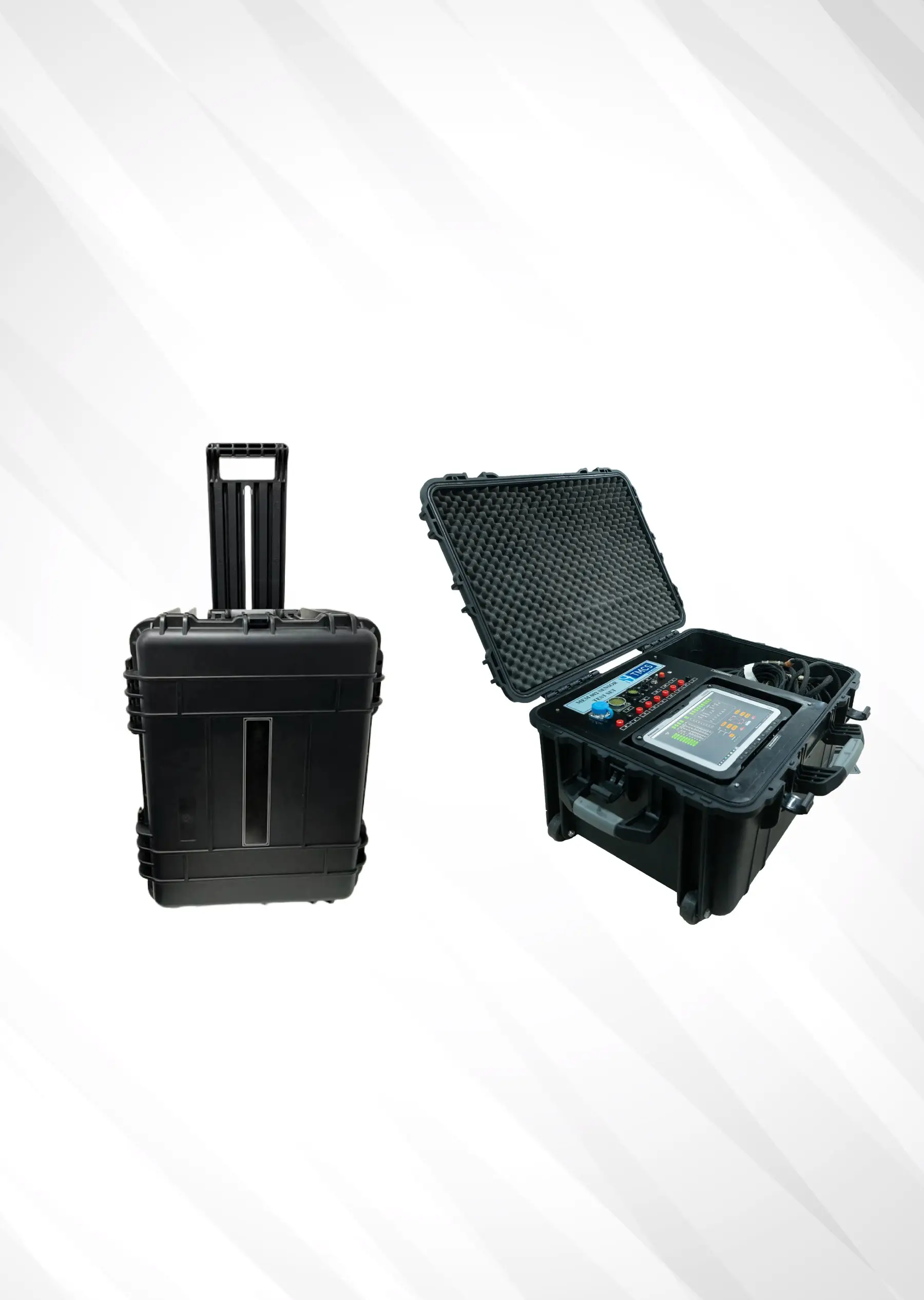
Automated real-time ECU testing, data logging, and reporting, enabling scalable validation across CAN, LIN, and Ethernet systems.
Real-time simulation and HIL system deployment
Automated test sequencing and reporting
Custom software development and operator interfaces
Embedded control and rapid prototyping
Modular high-performance validation platforms
Precision measurement and monitoring solutions
TMCS, as an NI System Integrator, develops advanced Hardware-in-the-Loop (HIL) systems using NI PXI, CompactRIO (cRIO), LabVIEW Real-Time, and FPGA modules for comprehensive automotive ECU validation. Our platforms simulate real vehicle dynamics to test powertrain ECUs, body electronics, chassis controllers, braking systems, ADAS, and vehicle network communication including CAN, LIN, and Automotive Ethernet. With deterministic real-time processing and closed-loop simulation, we enable fault injection, functional safety validation, and performance verification. TMCS HIL systems reduce development cycles, improve reliability, and ensure production-ready ECU performance before on-road deployment.
TMCS delivers NI-based HIL solutions for Battery Management Systems (BMS), inverters, motor controllers, and EV charging systems using NI PXI, FPGA-based controllers, and LabVIEW software. Our real-time battery and powertrain simulation platforms replicate dynamic load profiles, grid conditions, and fault scenarios to validate SOC/SOH algorithms, protection mechanisms, and power electronics behavior. The system supports high-speed data acquisition, closed-loop testing, and safety-critical validation. Designed for electric vehicle and energy storage development, TMCS HIL solutions accelerate innovation while ensuring compliance with automotive and grid standards.
Leveraging NI PXI, CompactRIO, and LabVIEW FPGA, TMCS builds high-fidelity HIL systems for flight control computers, avionics, UAV controllers, and mission-critical defense electronics. Our platforms provide deterministic real-time simulation of aircraft dynamics, actuator models, and sensor feedback for closed-loop validation. Fault injection, redundancy testing, and safety logic verification are performed in controlled laboratory environments. TMCS HIL solutions help aerospace and defense organizations reduce integration risks, improve reliability, and support certification processes for safety-critical embedded systems.
TMCS provides NI-powered HIL systems for validating PLCs, motion control systems, robotics controllers, and industrial drives. Using CompactRIO, PXI, and LabVIEW Real-Time, we simulate plant models, machine dynamics, and process conditions for closed-loop control validation. Our digital twin-based HIL platforms enable testing of automation logic, safety interlocks, servo performance, and machine sequencing before field deployment. Designed for smart manufacturing environments, TMCS solutions reduce commissioning time, minimize downtime, and improve overall system performance and operational reliability.
TMCS develops advanced HIL solutions using NI PXI and FPGA-based real-time controllers for renewable energy systems, smart grid controllers, and grid-tied inverters. Our platforms simulate grid disturbances, load variations, harmonic conditions, and protection scenarios to validate power electronics and control algorithms. With high-speed data acquisition and deterministic processing, TMCS HIL systems ensure compliance with grid codes and safety standards. These solutions enable safe testing of distributed energy resources and advanced power conversion systems in controlled environments.
TMCS designs NI-based HIL platforms for traction control units, propulsion systems, and safety-critical controllers in railways, marine vessels, and off-highway equipment. Using PXI, CompactRIO, and LabVIEW FPGA, we simulate dynamic operating loads, braking systems, and real-world environmental conditions. The system supports autonomous control validation, redundancy checks, and fault scenario testing in real time. TMCS HIL solutions enhance system durability, reduce field failures, and ensure compliance with transportation safety standards before deployment.

Develop test automation, real-time models, and communication interfaces

Perform FAT, on-site installation, and system validation

Provide calibration, upgrades, maintenance, and long-term technical support

Define system objectives, ECUs, I/O signals, test scenarios, and real-time constraints

Design an NI-based HIL architecture aligned with performance needs

Integrate real-time processors, sensor emulation, load simulation, and fault injection
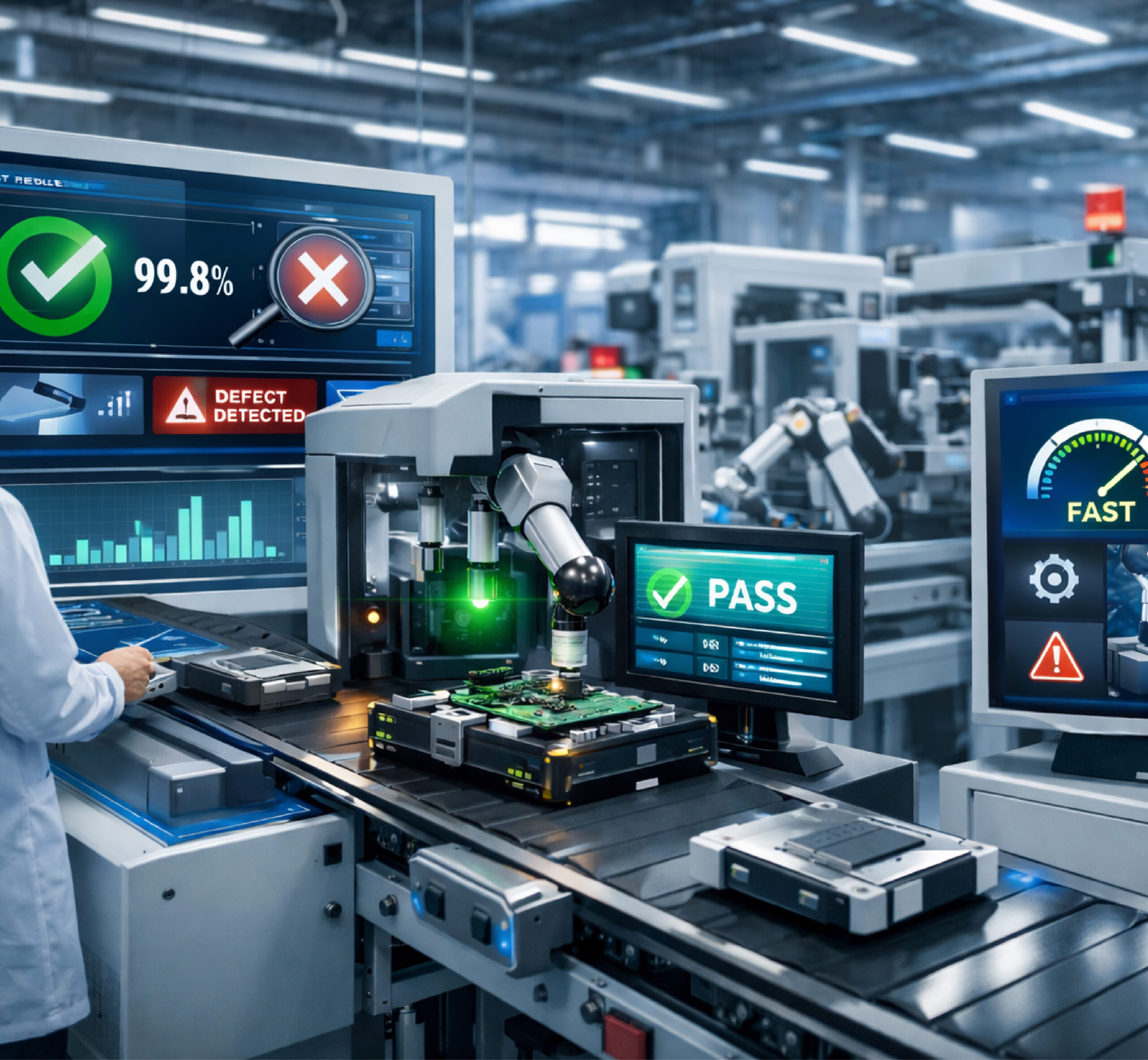
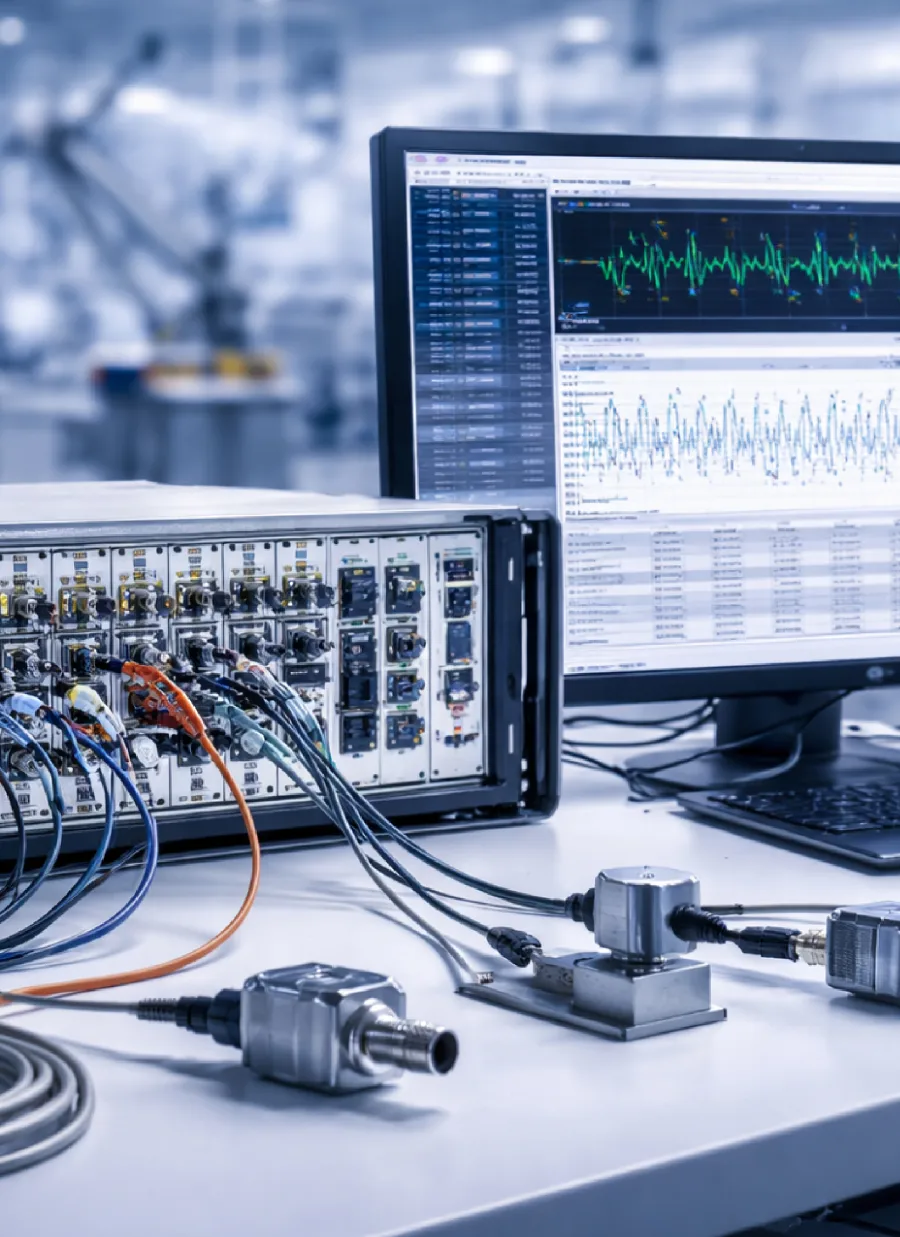


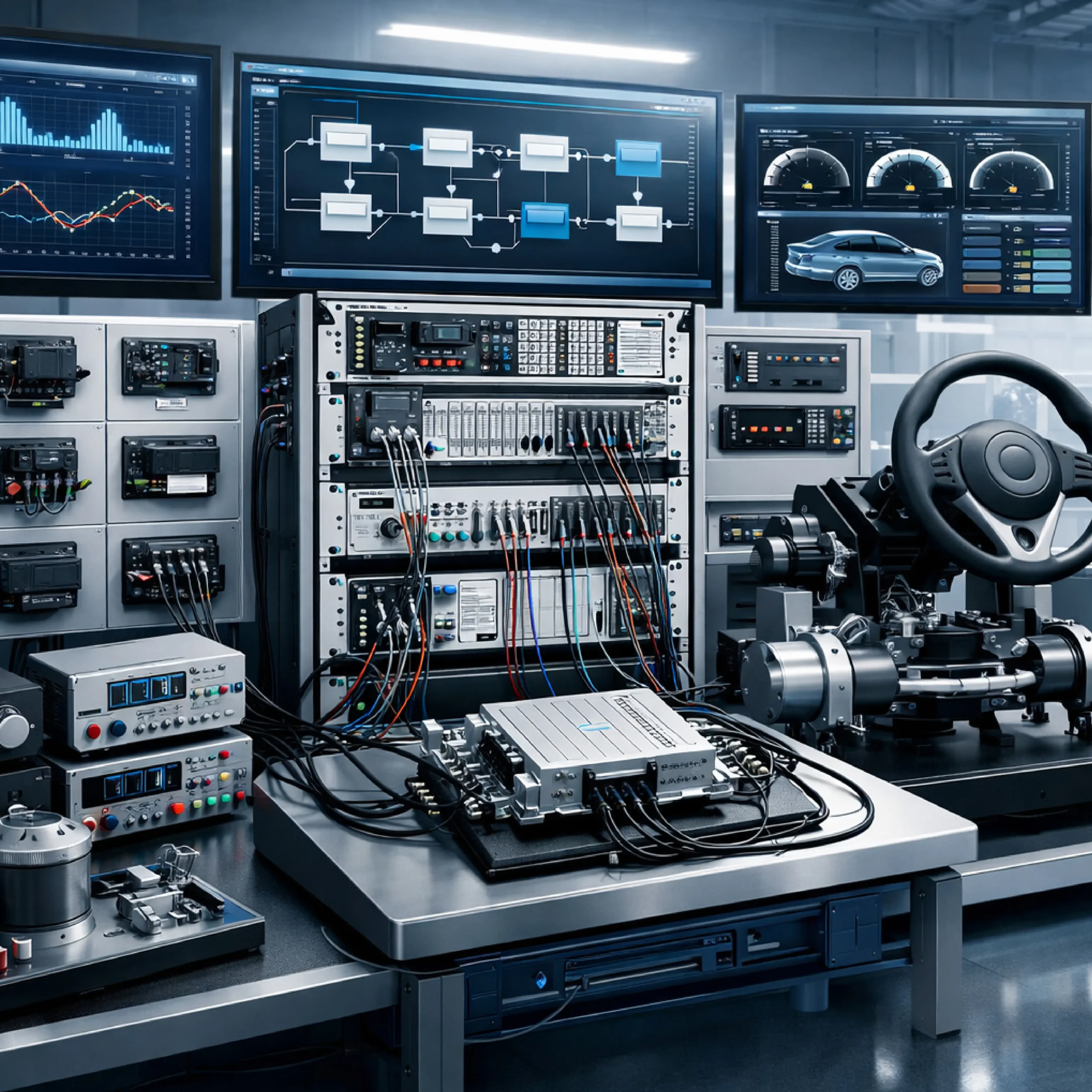
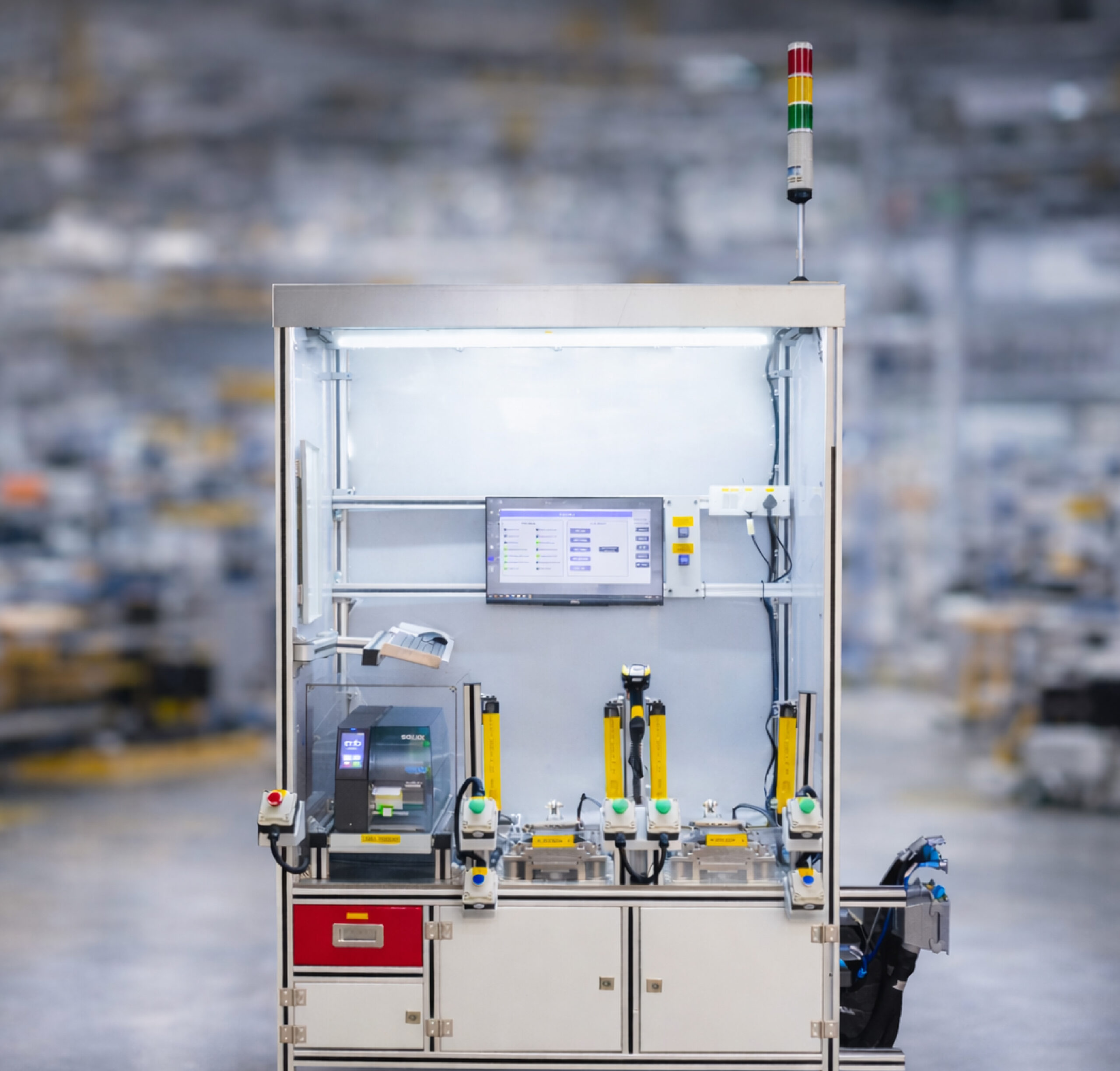



High-precision automated DAQ system that tests 12 drives simultaneously, ensuring accurate measurements, reduced testing time, and reliable high-throughput performance.
Precision-engineered ABS Solenoid Test Bench integrating NI DAQ hardware and LabVIEW automation to accurately control and monitor pneumatic brake pressure, temperature, and current across multiple solenoids, ensuring high repeatability, real-time analysis, and reliable performance validation.
E-Axle Test Bench, engineered with NI hardware, LabVIEW automation, PLC control, and precision torque/RPM measurement to deliver adaptable, production-ready testing for multiple axle variants with complete braking, oil management, and performance validation in one integrated solution.
Precision-engineered ABS Solenoid Test Bench integrating NI DAQ hardware and LabVIEW automation to accurately control and monitor pneumatic brake pressure, temperature, and current across multiple solenoids, ensuring high repeatability, real-time analysis, and reliable performance validation.
Request a HIL Feasibility Discussion
AR Bhat Bhavan, MCCIA Building, Tilak Road, Pune – 411002, Maharashtra, India.
Unit 1: Shed No. 4, Satyam Industrial Estate, Survey No. 25, Mahadev Nagar, Nanded Gaon, Singhagad Road, Pune – 411041
Toli Chowki, Hyderabad, Telangana, India – 500008
Phone +91 20 67636001
Email: sales@tmcs.in